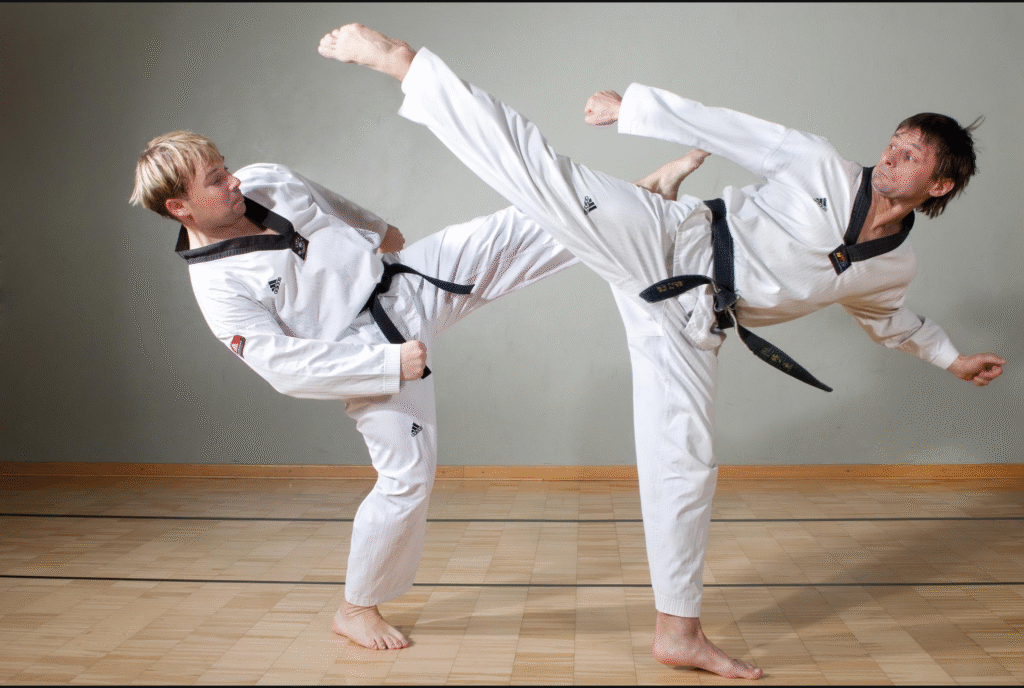
Who Are We?
This website was created by a dedicated Taekwondo instructor and lifelong practitioner whose journey in the martial arts spans years of disciplined training, continuous learning, and a deep respect for the traditions that define this Korean art. Taekwondo is more than a sport or hobby—it is a lifelong pursuit of personal development, physical excellence, and mental resilience.
The purpose of this website is to serve as both an introduction and a resource. For prospective students, it offers a clear and welcoming pathway into the world of Taekwondo—what to expect, what you will learn, and how it can benefit you. For those already familiar with martial arts, it provides a deeper exploration of Taekwondo’s history, philosophy, and global significance.
Whether your goal is to improve your fitness, learn practical self-defense, build confidence, or simply explore something new, Taekwondo offers a structured and supportive environment in which individuals of all ages and backgrounds can thrive. This site is designed to guide you through that journey, offering insight, context, and inspiration along the way.
What is Taekwondo?
Taekwondo is a Korean martial art that combines powerful kicking techniques, precise hand strikes, and fluid body movement with a strong philosophical foundation. The name itself is derived from three Korean words: “Tae” (foot or kick), “Kwon” (hand or fist), and “Do” (the way or path). Together, these elements describe not only a system of combat but also a way of life centered on discipline, respect, and self-improvement.
While Taekwondo is widely recognized for its dynamic and high-level kicking techniques—including spinning kicks, jumping kicks, and fast combinations—it is a comprehensive martial art that incorporates striking, blocking, footwork, patterns (known as poomsae), sparring, and self-defense applications. Each aspect of training is designed to develop both the body and the mind in a balanced and progressive way.
For prospective students, Taekwondo offers a structured curriculum that allows for measurable progress. Advancement is marked by a belt-ranking system, which provides clear goals and a sense of achievement at each stage. Classes typically include warm-ups, technical drills, forms practice, partner work, and controlled sparring, all guided by experienced instructors who emphasize safety, proper technique, and personal growth.
Historical Development of Taekwondo
To fully appreciate Taekwondo, it is important to understand its historical roots and evolution. Although modern Taekwondo was formally developed in the mid-20th century, its origins are deeply connected to Korea’s ancient martial traditions.
Early Korean practices such as Taekkyeon and Subak date back hundreds of years and were used for both self-defense and physical conditioning. These indigenous arts emphasized fluid movement, footwork, and striking techniques, many of which can still be seen in Taekwondo today.
During the Japanese occupation of Korea from 1910 to 1945, traditional Korean martial arts were suppressed, and Japanese systems such as Karate were introduced. Many Korean practitioners studied these arts, either in Japan or under Japanese instructors, and later integrated their knowledge with native techniques after Korea regained independence.
In the years following World War II, several martial arts schools, known as “kwans,” were established throughout Korea. Each kwan had its own style and interpretation of martial arts, often blending elements of Karate with Korean traditions. Throughout the 1950s and 1960s, efforts were made to unify these schools under a single national identity, leading to the creation and formalization of Taekwondo.
By the late 20th century, Taekwondo had grown rapidly beyond Korea’s borders. Demonstration teams, military training programs, and international organizations helped spread the art worldwide. Its inclusion as a demonstration sport in the 1988 Seoul Olympic Games—and later as an official Olympic sport in 2000—marked a significant milestone in its global recognition.
Today, Taekwondo is practiced by tens of millions of people in countries across the world, making it one of the most widely practiced martial arts in existence.
The Kukkiwon and Global Taekwondo
A central institution in the development and global standardization of Taekwondo is the Kukkiwon, also known as the World Taekwondo Headquarters. Established in 1972 in Seoul, South Korea, the Kukkiwon serves as the official governing body for Taekwondo promotion, education, and black belt certification worldwide.
The founding of the Kukkiwon represented a major step toward unifying Taekwondo’s technical standards and preserving its integrity as it expanded internationally. Prior to its establishment, variations between different schools and organizations made it difficult to maintain consistency in training and ranking. The Kukkiwon addressed this by creating standardized curricula, techniques, and testing requirements.
One of the Kukkiwon’s most important roles is the issuance of Dan (black belt) certifications. These certifications are recognized globally and signify a practitioner’s level of technical proficiency, knowledge, and commitment. For students, earning a Kukkiwon-certified black belt is a meaningful achievement that connects them to the broader international Taekwondo community.
In addition to certification, the Kukkiwon is responsible for:
- Developing and maintaining official poomsae (forms) used in training and competition.
- Educating and certifying instructors and masters through formal training programs.
- Promoting Taekwondo as both a cultural heritage and a modern sport.
- Supporting research and the continued evolution of Taekwondo techniques and pedagogy.
Closely associated with the Kukkiwon is World Taekwondo (WT), the international federation that governs Olympic-style Taekwondo competition. While Kukkiwon focuses on education and standards, World Taekwondo oversees rules, events, and international competition. Together, these organizations ensure that Taekwondo remains both a respected traditional art and a dynamic global sport.
Physical Benefits of Taekwondo Training
One of the most immediate and noticeable advantages of practicing Taekwondo is its impact on physical health. Unlike many fitness programs that isolate specific muscle groups or focus on a single aspect of conditioning, Taekwondo offers a holistic workout that develops the entire body.
Training sessions are designed to improve cardiovascular endurance through continuous movement, drills, and sparring. Over time, students experience increased stamina, allowing them to perform physical activities with greater efficiency and less fatigue.
Flexibility is another key benefit. Taekwondo’s emphasis on high and dynamic kicking requires regular stretching and mobility exercises, particularly in the hips, hamstrings, and lower back. As flexibility improves, students often notice reduced muscle stiffness and a lower risk of injury.
Strength development occurs naturally through repeated practice of techniques, stances, and conditioning exercises. The legs and core are especially engaged, as they provide the foundation for powerful kicks and stable movement. Upper-body strength is also developed through striking, blocking, and bodyweight exercises.
Balance and coordination are essential components of Taekwondo. Executing complex techniques—such as spinning kicks or combination movements—requires precise timing and body control. With consistent practice, students develop improved spatial awareness and motor coordination, which can carry over into other physical activities and daily life.
Mental and Emotional Benefits
While the physical benefits of Taekwondo are significant, its mental and emotional advantages are equally profound. Training is structured in a way that encourages discipline, focus, and self-awareness.
Students are required to learn and memorize patterns, follow instructions carefully, and maintain attention during practice. This helps improve concentration and cognitive function, skills that are valuable in academic, professional, and personal settings.
Taekwondo also provides an effective outlet for stress. Physical activity stimulates the release of endorphins, which can improve mood and reduce anxiety. At the same time, the structured and goal-oriented nature of training creates a sense of purpose and routine.
Confidence is built gradually through achievement. Each new technique mastered, each belt earned, and each challenge overcome reinforces a student’s belief in their own abilities. This confidence often extends beyond the training environment, positively influencing other areas of life.
Another important aspect is emotional resilience. Training is not always easy—students will face difficulties, setbacks, and moments of frustration. Learning to persevere through these challenges fosters mental toughness and adaptability.
Taekwondo as a Way of Life
For many practitioners, Taekwondo becomes more than a physical activity—it becomes a guiding philosophy. Core principles such as courtesy, integrity, perseverance, self-control, and indomitable spirit are emphasized throughout training.
These values are not limited to the dojang (training hall); they are meant to be applied in everyday life. Students are encouraged to treat others with respect, approach challenges with determination, and act with honesty and responsibility.
For prospective students, this means that joining a Taekwondo program is not simply about learning how to kick or punch. It is about becoming part of a tradition that promotes personal growth, community, and lifelong learning.
Whether you are seeking improved fitness, practical self-defense skills, or a meaningful and structured activity, Taekwondo offers a unique combination of physical challenge and personal development. It meets you where you are and provides a clear path forward, one step—and one kick—at a time.